
A common misconception is that a wallet becomes safe simply because it displays a warning before a transaction. In reality, security depends on several separate layers: who controls the private key, what the wallet can observe, how clearly it explains a contract interaction, and whether the user still verifies the final action. Rabby Wallet is designed around this broader problem. Developed by DeBank for DeFi users, it combines non-custodial key management with transaction simulation, risk scanning, and broad EVM network support.
That makes Rabby interesting for users in Germany and elsewhere in Europe who move between Ethereum, Layer 2 networks, stablecoin applications, decentralised exchanges, and bridges. But “more information” is not the same as “no risk”. The useful question is not whether Rabby is universally better than every alternative. It is where its particular design reduces friction, where it introduces trade-offs, and which users should still prefer a simpler or more isolated setup.
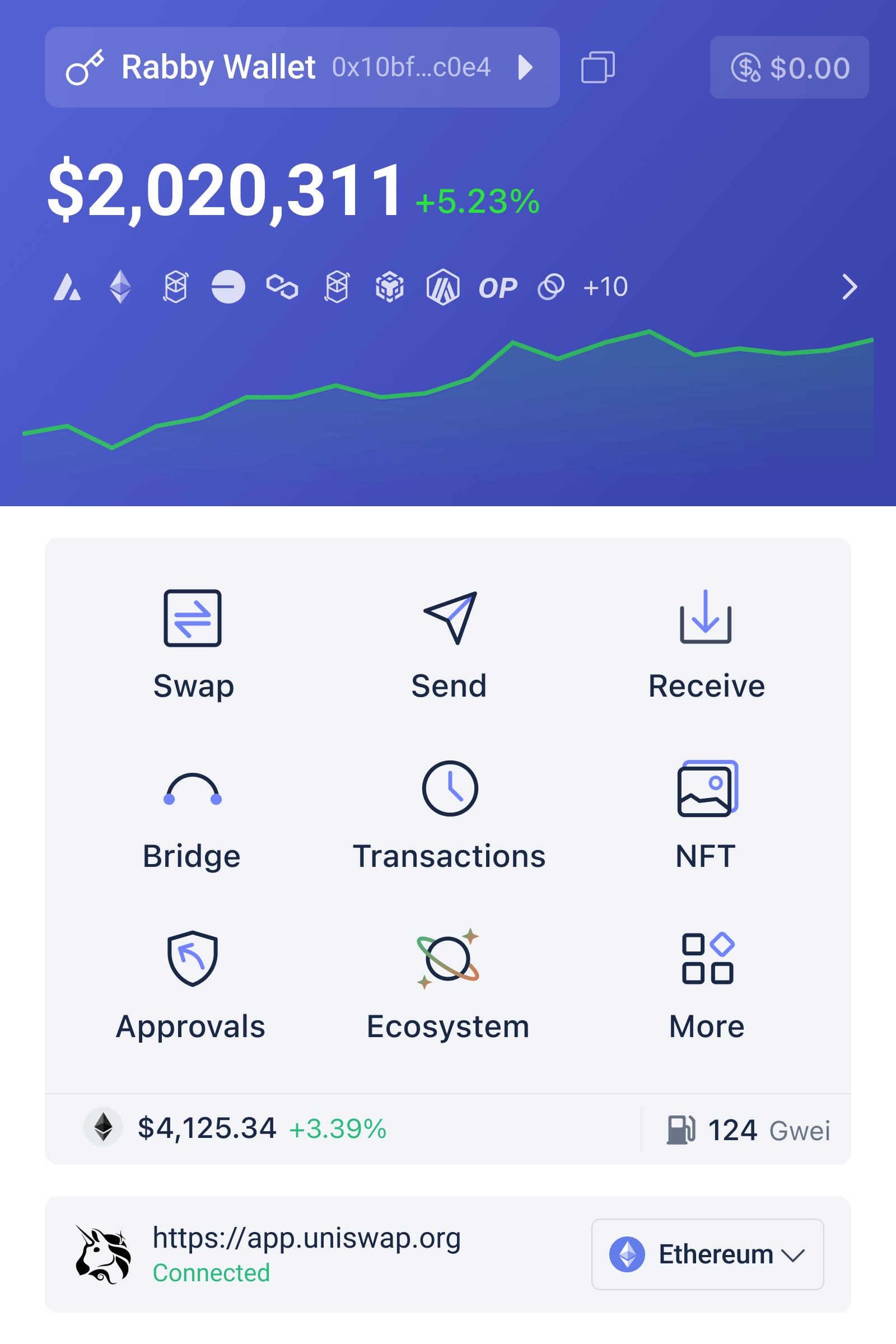
What Rabby changes in the wallet experience
Rabby is a non-custodial wallet. Its private keys are stored locally on the user’s device rather than transmitted to Rabby’s servers. This is the essential dividing line between a wallet and a custodial exchange account: the user remains responsible for the recovery phrase and signing authority. Rabby does not hold funds on the user’s behalf, and losing the recovery material can therefore have serious consequences.
Its distinctive role is that of an independent transaction checker. Rabby does not need to create or rewrite a transaction in order to explain it. Before signing, it simulates the expected result and presents changes to token balances and contract interactions. This matters because a transaction request that looks harmless in a dApp interface may contain an approval, a transfer, or a more complex call hidden behind technical data.
The security engine adds another layer by checking contracts and addresses for signals associated with phishing, known hacks, or unlimited token approvals. An unlimited approval allows a contract to spend a token balance within the terms of that approval, which can be convenient but increases the potential damage if the contract or interaction is compromised. Rabby’s warning system can make this risk visible at the moment when it matters.
There is, however, a boundary that should not be overlooked: a simulation describes an expected outcome under particular conditions. It does not turn an unsafe protocol into a safe one, guarantee that a website is genuine, or eliminate market risk, bridge risk, oracle failures, wallet malware, or social engineering. A user who approves a warning without understanding it has not gained much practical protection.
Rabby versus MetaMask: richer context, greater complexity
MetaMask remains the familiar baseline for many Ethereum users. Its main advantage is ecosystem recognition: most dApps expect it, tutorials describe it, and users often already know its interface. For someone who mainly uses one or two established networks and signs occasional transactions, that familiarity may be more valuable than additional dashboard information.
Rabby takes a different approach. It is built around a multi-chain workflow and supports more than 140 EVM-compatible networks, including Ethereum, Polygon, Arbitrum, Optimism, Avalanche, Base, and BNB Chain. Automatic network switching can remove a common source of frustration: connecting to a dApp while the wallet is still set to the wrong chain. The benefit is practical, but it also creates a new habit requirement. Users must understand which network an application is requesting rather than treating automatic switching as an approval signal.
For a DeFi user who regularly compares fees, moves collateral between networks, or interacts with several protocols, Rabby’s transaction preview is a meaningful advantage over a minimal signing screen. The trade-off is cognitive density. More warnings, simulation results, token changes, and network details require more attention. Rabby can make an experienced user faster and more informed, while making a first-time user feel that every transaction is a technical audit.
Both wallets can be used with hardware devices such as Ledger, Trezor, and OneKey. This distinction is important: the browser wallet provides the interface and transaction context, while the hardware wallet protects the signing key and requires physical confirmation. Combining both can reduce exposure, but it does not make the user immune to signing a malicious transaction displayed through a compromised or deceptive interface.
Rabby compared with hardware-first and mobile-first options
A hardware wallet used with a compatible interface is generally the stronger choice for long-term holdings because the private key is kept in a dedicated device. Its weakness is usability. Moving between chains, checking contract calls, and managing frequent DeFi activity can become slower and less transparent, particularly when the hardware screen cannot present the full economic meaning of a complex interaction.
Rabby is therefore best understood not as a replacement for hardware security, but as a more informative control panel that can sit in front of it. For active DeFi, that combination is often more rational than choosing between convenience and security as if they were mutually exclusive. The user can inspect the simulated outcome in Rabby and still require hardware confirmation for the signature.
Mobile wallets offer a different compromise. They are convenient for payments, monitoring positions, and occasional actions away from a desktop. Rabby provides mobile applications for iOS and Android as well as desktop versions for Windows and macOS, while its browser extension is primarily available for Chrome, Brave, and Edge. A user deciding where to rabby wallet extension should treat the official download path and browser-store identity as part of the security process. Installing a convincing imitation is a failure before any blockchain transaction begins.
For desktop DeFi research and frequent dApp connections, the browser extension is likely the most natural format. For a treasury or substantial long-term portfolio, a hardware-backed account and careful operational separation may be preferable. For everyday use, a mobile wallet may win on convenience. The best choice depends less on brand loyalty than on transaction frequency, asset value, and the user’s ability to review technical prompts.
Bridges, swaps, and the hidden cost of convenience
Rabby includes a swap aggregator that can scan decentralised exchange routes such as Uniswap and 1inch. In principle, aggregation can improve execution by comparing available routes and considering slippage, the difference between the expected and executed price. Yet the displayed rate is only one part of the decision. Liquidity, price impact, approval requirements, gas costs, and the trust assumptions of the selected protocol also matter.
The same principle applies to integrated bridging through services such as LI.FI. Keeping a bridge workflow inside the wallet reduces interface switching and may lower the chance of copying the wrong address or network. It does not remove the underlying bridge exposure. A bridge or routing layer may involve smart contracts, liquidity providers, token representations, and external messaging systems. Convenience changes the path through that risk; it does not abolish it.
Gas Account extends convenience by allowing network fees to be paid with stablecoins such as USDC across supported workflows, even when the user lacks the chain’s native token. This solves a real usability problem, especially when a user holds funds on one network but needs to make a small transaction on another. The limitation is that fee conversion and service availability remain part of the mechanism. Users should still understand what service is paying the native gas and how the conversion is performed.
Rabby Points, earned through actions such as swaps, gas top-ups, or referrals, add a loyalty layer. Such incentives may encourage experimentation, but they should not determine transaction selection. A reward is not compensation for smart-contract risk, poor execution, or unnecessary activity. In DeFi, the cheapest transaction is often the one not made.
How to install Rabby without weakening the security model
The safest installation process is deliberately uneventful. Use a verified official source, confirm the browser extension identity, and avoid sponsored search results or unsolicited download prompts. After installation, create or import an account only in the wallet interface, record the recovery phrase offline, and never enter it into a website, support chat, cloud note, or form.
Before connecting a valuable account, test the workflow with a small amount. Confirm that the selected network, recipient address, token, approval scope, and expected balance changes match the intended action. If the simulation shows an unexpected asset leaving the wallet, an unfamiliar contract, or an unlimited approval that is not necessary, stop rather than clicking through.
Open-source publication under the MIT licence improves inspectability because external developers can review the code. It is a valuable transparency property, but open source is not identical to a formal guarantee of correctness. Users must also consider browser security, operating-system updates, malicious extensions, phishing domains, and the possibility that a trusted protocol itself contains a vulnerability.
For German users, practical discipline also includes keeping records of transactions and distinguishing swaps, transfers, staking, and bridge operations. Wallet software may make these actions easier, but it does not automatically resolve tax classification or documentation duties. The interface can improve operational clarity; it cannot replace personal record-keeping or professional advice where the situation is complex.
What to watch as multi-chain wallets evolve
The recent positioning of Rabby in the Chrome Web Store continues to emphasise an open-source Ethereum and EVM wallet designed for a smooth multi-chain experience and protection-oriented workflows. The important signal is not merely the number of supported networks. It is the direction of wallet design: wallets are becoming interpretation layers that explain what a dApp intends to do before the user signs.
If simulations become more accurate, warnings more contextual, and hardware integration more readable, active DeFi users may gain a substantially better decision environment. If network complexity grows faster than explanation quality, the opposite could happen: users may receive so many alerts that they learn to dismiss them. The key measure to watch is therefore not feature count, but whether the interface helps people distinguish a routine approval from a materially dangerous one.
Rabby Wallet FAQ
Is Rabby Wallet custodial?
No. Rabby is non-custodial, and private keys are stored locally on the user’s device. The user controls the recovery phrase and remains responsible for backing it up securely and preventing unauthorised access.
Does transaction simulation guarantee that a transaction is safe?
No. Simulation shows expected state changes and can expose suspicious approvals or unexpected transfers, but it cannot eliminate smart-contract bugs, phishing, bridge failures, malware, or market risk. Treat it as a review aid, not an insurance policy.
Is Rabby better than MetaMask?
It depends on the use case. Rabby is often a stronger fit for active multi-chain DeFi users who value previews and risk signals. MetaMask may be preferable for users who prioritise familiarity, broad instructional support, or a simpler interface.
Should Rabby be used with a hardware wallet?
For significant holdings, combining Rabby’s transaction visibility with a Ledger, Trezor, or OneKey device can be a sensible setup. The hardware wallet protects the key, while Rabby helps explain the transaction. The user must still verify what is being signed.
Rabby’s central value is not that it makes DeFi safe by default. Its stronger contribution is more precise: it can make the intended consequences of a transaction easier to inspect before an irreversible signature. That is a meaningful improvement for multi-chain users, provided the information is treated as evidence to evaluate rather than permission to proceed.